
Lecture 3: Four Core Principles pt.2
Summary
Opportunity Cost Takeaways
- Opportunity Cost is the most valuable alternative you give up to pursue said choice
- Every choice has opportunity cost, even non-monetary choices
- Ignore sunk costs
- PPF is used to visualize opportunity cost
- Scarcity creates limitations and opportunity cost
Marginal Principle Takeaways
The marginal principle tells you to break “how many” decisions into a series of smaller, marginal decisions.
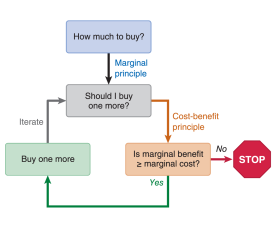
- If the marginal benefit exceeds the marginal cost, then buy that additional unit.
- Continue to buy additional units as long as the marginal benefit is at least as large as the marginal cost (rational rule).
- Stop when the marginal benefit equals marginal cost.
- Economic surplus is maximized when marginal benefit equals marginal cost.
Interdependence Principle Takeaways
Your choices depend on:
- Your other individual choices
- The choices others make
- Developments in other markets
- Expectations about the future
Shortened Economic Principles
- The Marginal Principle (One more?)
- The Cost-Benefit Principle (Do benefits exceed costs?)
- The Opportunity Cost Principle (Or what?)
- The Interdependence Principle (What Else?)
Recap
In the last lecture, we learned about the Opportunity Cost Principle, which is the most valuable alternative you had to give up to pursue your choice (“what else?").
We discussed lists of opportunity costs, but there are ways to also visualize opportunity costs!
Production Possibilities Frontier (PPF)
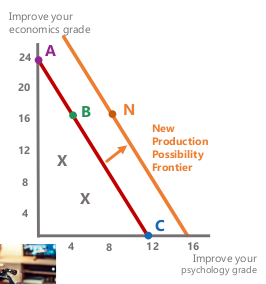
A PPF Shows the different sets of output that are attainable with your scarce resources. 
Example 1: Let’s say you have 3 hours to study for a Psychology and Economics Exam.
If you spend an hour studying for Econ:
- You gain 8 points in Econ
- You lose 4 points in Psych
By moving up or down the graph, you are sacrificing something, which is your opportunity cost
Therefore, the opportunity cost by studying 1 hour for Econ is 4 points in Psych.
To reach a point with no sacrifices, you must change another factor that will create a new PPF (N), otherwise this is not possible
Marginal Principle
The Marginal Principle states that decisions with quantities should be made incrementally
- Instead of “how many”, think “one more”
Marginal Benefit: The extra benefit from one extra unit
Marginal Cost: The extra costfrom one extra unit
In order to evaluate when to apply the Marginal Principle, use the Figure below.
Rational Rule
Based off the Cost-Benefit Principle, we know that as long as the benefits exceed the costs of a choice, it is a good choice. The same applies to Marginal Analysis on an incremental level.
Rational Rule: Keep doing something until Marginal Costs = Marginal Benefits
Interdependence Principle
According to the Interdependence Principle, the best choices depends on:
- Your other individual choices
- You have limited resources
- By doing one choice, you cannot do another
- Things like time, money, energy are all factors
- The choices others make
- Other economic actors shape your choices
- Other people, businesses, and governments affect this
- Developments in other markets
- Changes in a market affect choices
- If a market is doing bad, you may change to another market
- Changes in prices and opportunity affect this
- Expectations about the future
- Should I act today, tomorrow, or never
- Doing something today shapes future decisions
Personal Note
- A bunch of people just left class early, felt bad for prof